Weapons as Love Letters
FIELD NOTES
Valkyrie
9/19/20253 min read
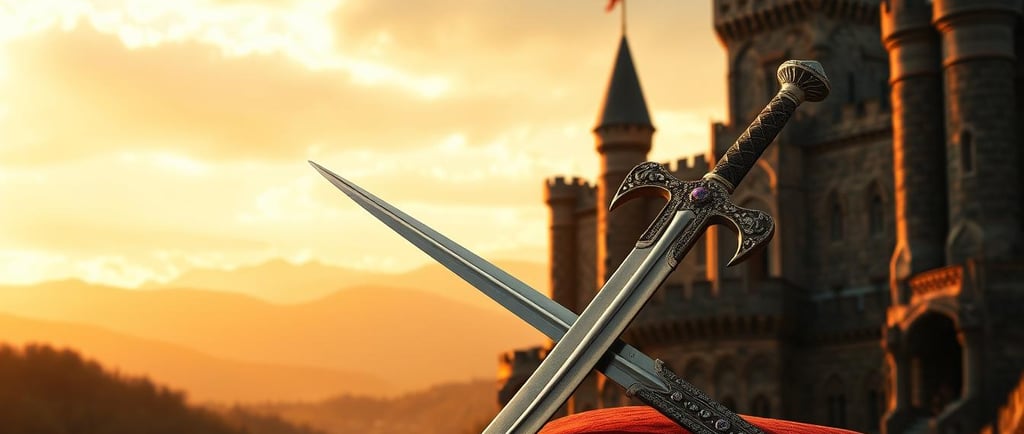
Power and vulnerability have always been lovers. They meet at the blade’s edge, in the gleam of polished steel, in the taut draw of a bowstring. We speak of weapons as engines of war, but their deeper story is more intimate: they are also emblems of devotion. A sword given is a vow; a spear passed down is a blessing. Desire and defense share the same sheath.
The Paradox of Affection Wrought in Steel
Weaponry is a paradox made solid—both kiss and wound, tenderness and terror. To gift a blade is to blur the line between protection and destruction, to whisper: my love for you is so fierce, I will arm you with my very soul.
Gifting the Blade, Gifting the Self
Across centuries, to present a weapon was never a casual gesture. Vikings pressed swords into the hands of kin as if pouring blood into another’s veins. Samurai believed their blades carried a spirit—tamashii—that bound wielder and steel as one. Native peoples infused their weapons with prayers and ancestor breath, so that each arrow carried both precision and blessing.
The act is never about the metal alone. It is a covenant.
Forged in Fire, Tempered in Love
Picture the forge: sparks like falling stars, the anvil ringing with each strike. In that crucible of flame and labor, something more than iron is made. Each stroke is devotion, each quench a baptism. A weapon, at its birth, carries the fingerprints of its maker, their longings hammered deep into its core.
To give such a creation is to give away a piece of one’s very being.
What Blades Speak When We Listen
Weapons speak their own dialect.
Swords murmur of honor, loyalty, and lineage.
Bows whisper patience, precision, the grace of waiting for the right moment.
Each shape and edge is a sentence in the language of power and care, a way of saying: I love you enough to keep you safe, even when I am gone.
Feminine Hands on the Hilt
The myth of weaponry has long been bound in masculine script, yet women have always taken up arms—Amazons, onna-bugeisha, resistance fighters, mothers with daggers hidden in their skirts. For them, the weapon was never mere ornament but an extension of defiance, endurance, and love that refused to bow.
In the modern world, a woman’s “armament” may be her words, her boundaries, her refusal to soften for others. A blade is a metaphor she wears openly: protection, autonomy, desire made visible.
Love as the Urge to Guard
To protect is to love at its most primal. Lovers lock doors, mothers sharpen knives, friends walk each other home at midnight. In these gestures, vulnerability and strength are braided together. We protect because we fear losing what we cherish. We arm because our hearts are fragile.
The paradox is exquisite: the most lethal gestures often spring from tenderness.
The Warrior’s Bond
Throughout history, warriors named their weapons as if they were beloved companions. A named blade is no longer an object; it becomes an ally, a vessel for courage, a mirror of the soul. Steel ceases to be neutral. It listens, it remembers, it guards.
What is this if not intimacy?
When Love Transfigures Power
Love has always been transformative—turning weakness into fire, turning fear into vigilance. Survivors of grief and war often keep talismans—sometimes blades, sometimes poems—that remind them of resilience. The weapon, literal or symbolic, is both shield and shrine.
In our digital age, the “weapons” of devotion have changed: shared passwords, protective firewalls, tracking apps to ensure someone made it home. They may not glitter like swords, but they carry the same vow—I will guard you even in unseen realms.
The Warrior’s Heart
To hold a weapon is to admit the duality in ourselves: the capacity to wound and to shelter. The warrior’s heart beats between those poles, fierce and tender. The beauty lies not in the steel itself, but in the love that demands such strength.
Weapons, then, are not simply tools of conflict. They are love letters written in iron, strung in sinew, tempered in fire. They are promises to protect, to remember, to endure.
And perhaps that is the greatest paradox: that the sharpest blades are forged not only from war, but from devotion.
© 2025. All rights reserved.