
The Erotics of Apocalypse
FIELD NOTES
Valkyrie
9/17/20255 min read
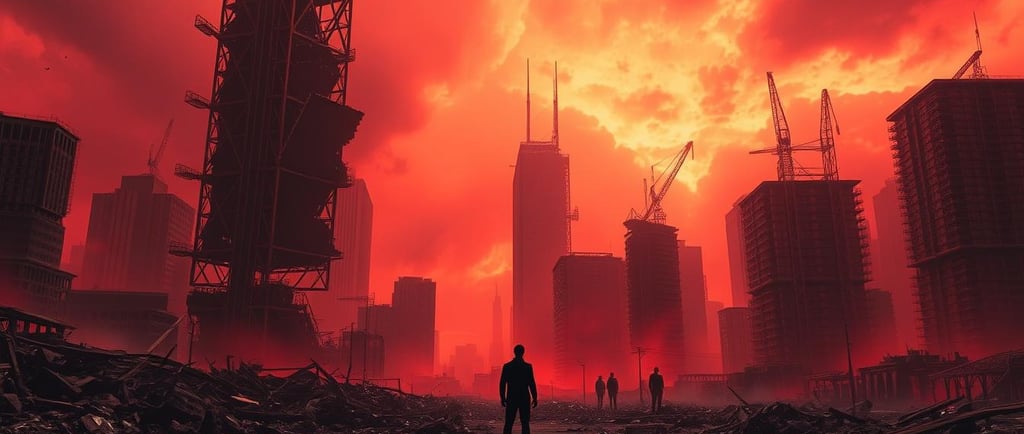
The end has always been dressed in lace. Beneath its tattered robes, apocalypse carries the musk of forbidden thrill - a collision of desire and annihilation. In chaos, human complexity is revealed, where the sacred meets the profane. Destruction's imagery often carries a sensual, almost erotic undertone. This fascination goes beyond the literal. Death and eros are siblings, twin specters who stalk the edges of myth and memory. To speak of endings is to touch the secret pulse of longing.
When the world buckles, when fire licks at the horizon and the sky unthreads itself, something in us stirs - half terror, half arousal. Collapse bares us raw. It strips the polite varnish from our days and reveals the animal underneath: trembling, hungry, unashamed.
The fusion of apocalyptic and erotic taps into our primal nature. It's both captivating and unsettling. Exploring this relationship, we discover the layers of meaning in our responses to the unknown.
The Seductive Pull of Ruin
Our culture is intoxicated with wreckage. The allure of the apocalypse has long captivated humanity, drawing us into a complex dance of fear and desire. This paradoxical attraction is woven into our culture, manifesting in various forms of media and art. We polish ruins until they gleam like jewels, stage slow-motion scenes of skyscrapers falling as if they were stripteases. What is the apocalypse if not the ultimate spectacle? Fear and desire blur until the trembling becomes indistinguishable from delight.
Decay has its own beauty. A cathedral crumbling is as sensual as a body disrobing. Collapse whispers what permanence never can: you will lose this, so touch it harder now. Ruins symbolize what has been lost, and the transience of human achievement.
The idea of collapse, whether societal, environmental, or existential, holds a certain allure. This collective fascination can be seen as a form of morbid curiosity, where the unknown and the uncontrollable become objects of desire.
Fear as Foreplay
Biologically, adrenaline prepares the body for 'fight or flight,' a response that can be linked to heightened states of arousal. This connection underscores the intricate link between our physiological responses and our emotional states. The body does not always dintinguish between terror and thrill. Adrenaline floods us with a primal electricigy, sharpening sensation, quickening pulse. To flee or to fuck - it is all the same breathless heartbeat.
Understanding this dynamic is crucial to grasping why the apocalypse, with all its terrors, can also be a source of fascination and even erotic allure. It's a testament to the complex and often contradictory nature of human desire. This is why we find ourselves half in love with extinction. The apocalypse seduces because it promises climax: total release, the orgasm of obliteration.
Ancient Fantasies of the End
The concept of the apocalypse has been a part of human history since its inception. It fascinates us with a blend of fear, curiosity, and a hint of eroticism. This ongoing fascination stems from the intricate dance between destruction and desire. It has been explored across cultures and through the ages.
From Mesopotamian floods to Ragnarok's fire and ice, our ancestors embroidered their endings with erotic threat. Gilgamesh's flood carried undertones of divine intimacy; Revelation drips with sensual excess - whore, beast, and bride tangled in fevered prophecy. Tantric cosmologies saw dissolution not as horror but as ecstatic release, the universe shuddering into rebirth.
Endings are never just about death. They are preludes to renewal, foreplay for creation's next gasp.
Freud, the Death Drive, and the Little Death
Freud named it plainly: the death drive, our compulsion to return to nothingness. But he might as well have been writing about orgasm - the petite mort - our brief rehearsal of extinction. Both pleasures, little and ultimate, are threshold experiences, undoings that remind us how thin the veil really is.
The apocalypse, then, is simply the world's little death, the cosmos arching its back toward dissolution.
Cinema's Disaster Porn
Hollywood knows this instinct well. Watch landmarks crumble in languid slow motion, towers falling like lovers surrendering. Amidst the spectacle, lovers clutch one another tighter, confessions spilling at the eleventh hour. It is alwyas the end of the world when someone finally says I love you.
Literature's Lingering Caress
Writers linger on destruction like tongues on a bruise. Apocalyptic fiction strips society's clothing, inviting taboo, transgression, excess. The language itself often grows fevered - lush descriptions of fire, ash, and collapse read like love poetry to impermanence. To read them is to be ravished by ruin.
Myth and Rebirth: Phoenix, Ragnarok, and Beyond
In Norse myth, the gods burn and drown only to make way for a softer dawn. The phoenix combusts, then rises, feathers still smoldering. Death is foreplay; rebirth is the afterglow. Our myths know what our bodies already whisper - that endings and beginnings are not separate but one endless cycle of desire and release.
Digital Doomsday
Online, we flirt with apocalypse daily. Hashtags of ruin trend like perfumes; VR offers extinction as a safe kink, a playground where annihilation can be tasted without consequence. We swipe through destruction with voyeuristic glee, arounsed by the nearness of the abyss.
Climate Crisis as Sublime Seduction
Even the slow violence of our warming planet is eroticized. Storm surges and wildfires are painted in the language of awe - terrible, yes, but breathtaking. Capitalism profits from this doom-lust, selling survival gear and bunker fantasies while we secretly thrill at the idea of being undone by nature's raw hand.
Political Apocalypticism: Power, Domination, and End-Time Rhetoric
In politics, the apocalypse is often used to gain control. This tactic has been around for ages. Leaders have harnessed apocalyptic fears to solidify their power and dominance.
Authoritarian regimes use apocalyptic tales to legitimize their rule. They promise salvation to those who submit, creating a sense of urgency. This urgency justifies their authority.
The offer of salvation for obedience is a powerful seduction. It satisfies the deep desire for security and order. This makes people more willing to follow the regime's lead.
Revolutionary politics, on the other hand, see their struggle as a form of erotic destruction. They view the overthrow of existing systems as a liberation.
This view sees the dismantling of oppressive structures as a liberating force, like a sexual release. It's a compelling narrative that drives revolutionary passion.
Personal Apocalypses
Not all endings come with trumpet blasts. Sometimes the apocalypse is just the loss of a lover, the hollowing ache of grief. To love is to flirt constantly with annihilation - because every attachment promises one day to break. We cling hearder, we confess sooner, because everything is fragile.
The little death in our beds, the big death at the end of all things - both are intimacies that undress us completely.
Embracing the End
To long for the apocalypse is not only to long for destruction. It is to crave transformation. To burn down what cages us, to taste teh ecstatic edge where fear becomes freedom.
Perhaps that is the true eroticism of apocalypse: it reminds us that nothing lasts, so every kiss is urgent, every touch divine. To love in the shadow of the end is to love completely, ferociously, without apology.
© 2025. All rights reserved.