Cleopatra at Ragnarok
Mythology Mashup
WRIT ON BONE
Valkyrie
10/15/20252 min read
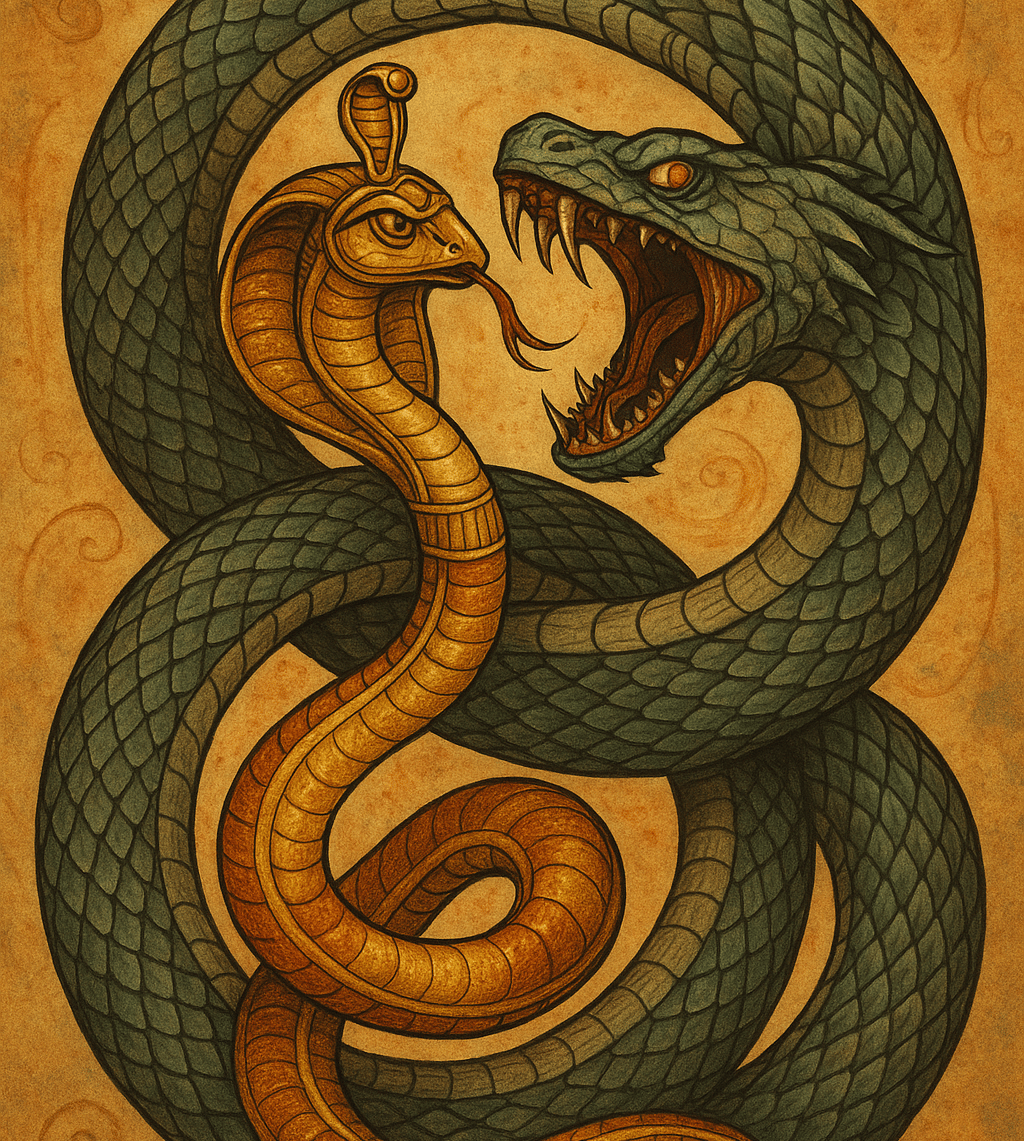
Picture it: the twilight of gods, the sky ablaze with Surtur’s fire, Fenrir’s jaws unhinged upon the world—and there, striding through the smoke as though it were incense in a temple, Cleopatra. Not the painted caricature Rome gave us, but the sovereign of the Nile herself, draped in gold and strategy.
What business has Egypt’s last pharaoh at the end of the Norse world? Only this: endings call to endings, and when one civilization burns, another ghost leans close to watch.
The Queen of the Nile Meets the Wolf’s Maw
It is not so much a clash as an overlay—a palimpsest of power. Cleopatra brings with her the cunning of the court, the mathematics of alliances, the practiced art of survival against empires that consume everything. The Aesir, for all their thunder, are children of fate. She, by contrast, was mistress of it, bending the tides of Rome with little more than a barge, a glance, and a wager most men would not dare place.
Imagine Odin regarding her across a hall thick with ash, his ravens unsettled by the weight of her gaze. Two strategists, two sovereigns, one world about to collapse.
Serpents and Sovereignty
No myth is without its serpent. The Norse have Jörmungandr, vast enough to choke oceans. Egypt birthed Apophis, chaos incarnate, forever threatening Ra’s passage through the night. Cleopatra herself wore Uraeus at her brow, the rearing cobra of divine rule.
Three serpents, one queen, one twilight. Which does she command? Which does she resist?
Perhaps she would not fight Fenrir with blade or Thor with storm, but instead seat herself beside Loki, whose laughter sounds too much like the whispers of courtiers back in Alexandria. Trickster meets queen, chaos meets cunning—a duet where betrayal is foreplay.
The Diplomat in the Ashes
Where the gods thirst for valor, Cleopatra thirsts for survival. She would not hurl herself into destiny’s mouth like Thor or Freya. Instead, she would weave—binding Freya with shared sovereignty of beauty and blood, coaxing Thor with admiration for his brawn, keeping Loki close but never trusted.
Odin might find in her a mirror: someone willing to lose everything in the name of foresight. Perhaps that is why she must stand at Ragnarok—because she knows too well what it is to rule at the edge of collapse, to reign while the empire beneath you fractures.
Death, Rebirth, and the Aftertaste of Ash
Both Egypt and the Norse knew time not as a straight line but a wheel: kingdoms fall, gods die, and yet from the tomb or the ash, something green stirs. Ragnarok births a new world. The Egyptian afterlife, too, was a passage—not an end but a transformation.
Cleopatra at Ragnarok is not just fantasy—it is recognition. She is a cipher for endings, for the kind of beauty that does not soften but sharpens in the face of collapse. If the Nile queen stood in the smoke of that northern twilight, it would not be as a guest, but as one who understands: death is never the end, only the most dramatic interlude.
© 2025. All rights reserved.